

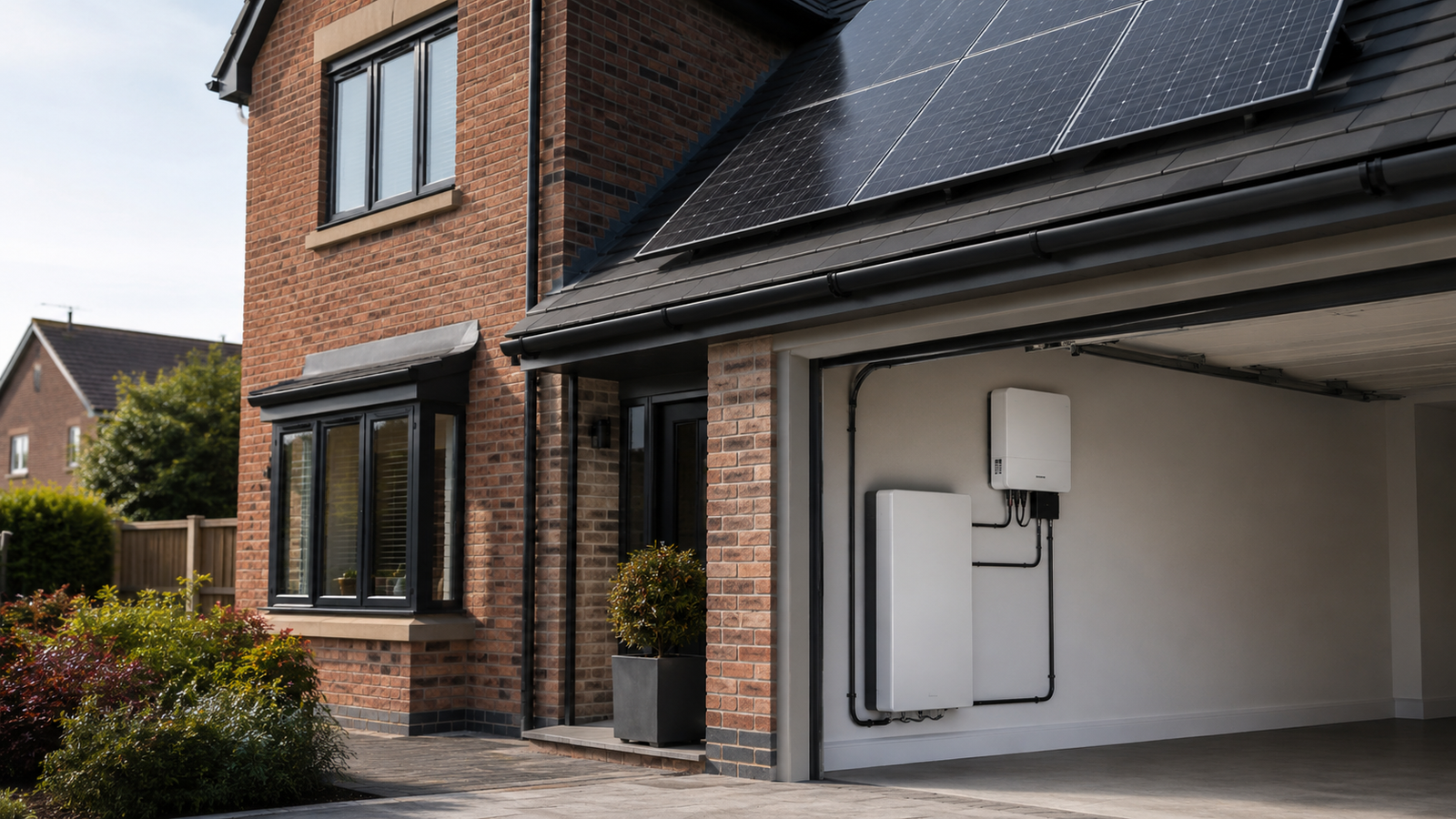
House battery storage lets a home keep electricity for later instead of using it the moment it is generated or bought from the grid. In a UK property, that usually means storing surplus solar power, charging from a cheaper overnight tariff, or combining both strategies.
The idea is simple, but choosing the right system is not. Battery capacity, power output, electricity-use patterns, tariffs, installation design and future plans all affect whether a battery is genuinely useful. A battery also does not automatically provide whole-house backup during a power cut.
For most homeowners, the best starting point is not a particular brand or battery size. It is understanding what you want the battery to do.
How home battery storage works
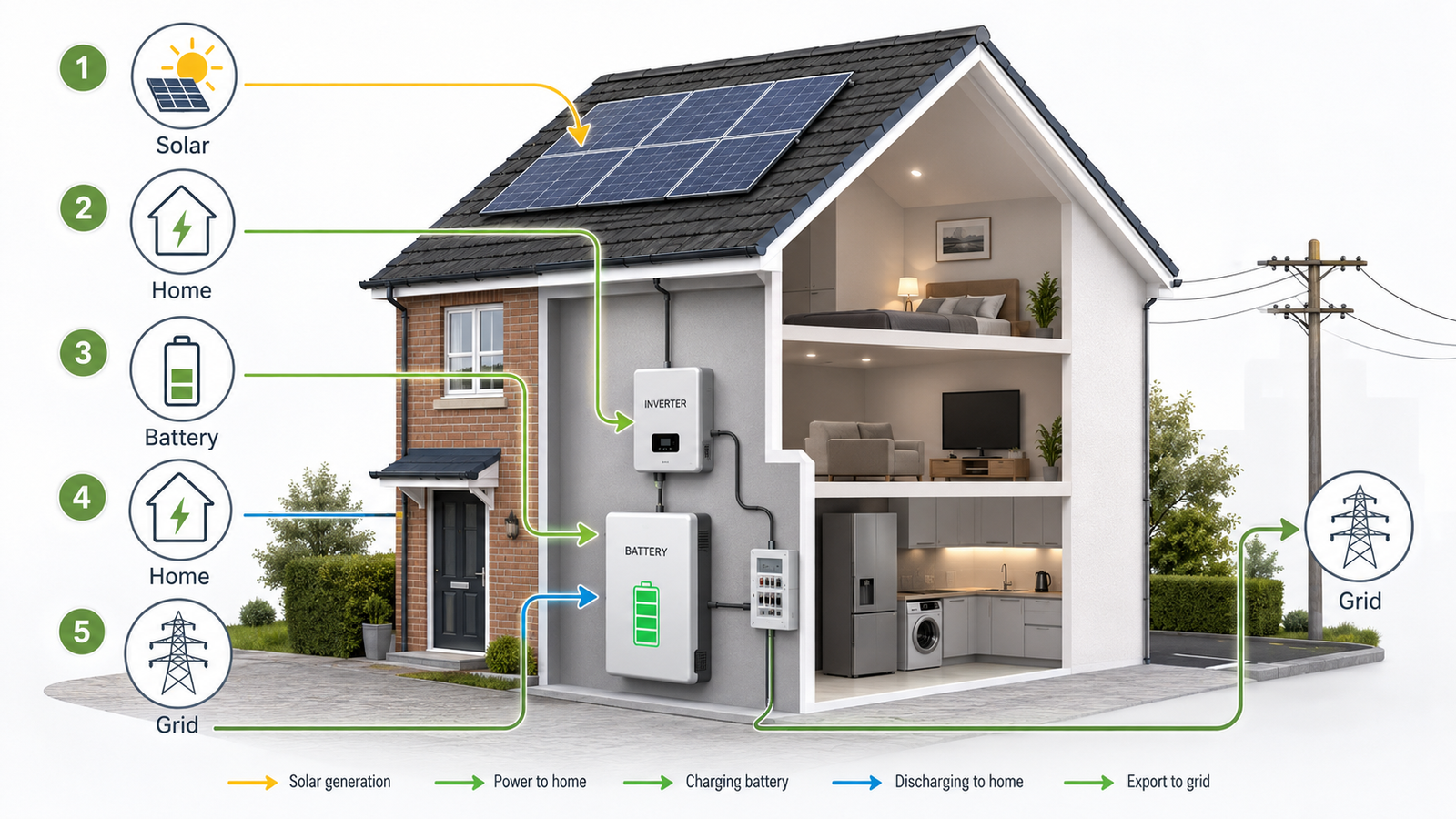
A home battery shifts electricity from one part of the day to another.
With solar panels, the system may work like this:
- Solar panels generate electricity.
- The house uses what it needs first.
- Excess generation charges the battery.
- Stored energy is used later, often during the evening.
- Additional surplus can be exported once the battery is full, depending on the system and tariff.
Without solar panels, the battery can instead charge from the grid.
A household on a suitable time-of-use electricity tariff could, for example, charge during a cheaper overnight period and use that stored electricity during a more expensive daytime or evening period.
That means a battery is not simply a solar accessory. Its broader purpose is to move electricity from a time when it is abundant or cheap to a time when it is more valuable to the household.
Can you have a home battery without solar panels?
Yes.
A battery-only system can charge directly from mains electricity. The financial case normally depends heavily on the household’s tariff.
Suppose a tariff offers a substantially cheaper charging window overnight. The battery could charge during that period and later supply part of the home’s daytime demand.
The potential saving depends on several things:
- the difference between cheap and expensive electricity rates
- how much energy the battery shifts each day
- charging and discharging losses
- the battery’s installed cost
- how often the battery is actually used
A small tariff difference may not create enough value to justify an expensive battery. A larger difference combined with regular daily cycling can make the economics more attractive.
Solar changes the calculation because some of the charging energy may otherwise have been exported rather than purchased from the grid.
How much battery storage does a house need?
There is no reliable rule such as “a three-bedroom home needs 10 kWh”.
House size tells you surprisingly little about electricity demand.
Two similar properties can have very different consumption because one household may have an electric vehicle, heat pump, electric cooking and people working from home while the other does not.
The better way to size a battery is to look at how much electricity the home actually uses and when it uses it.
Useful inputs include:
- annual electricity consumption
- half-hourly or smart-meter usage
- evening and overnight demand
- daytime solar surplus
- cheap-tariff charging opportunities
- future EV charging
- future heat-pump demand
- whether backup power is required
A battery designed mainly to store midday solar surplus may need a different capacity from one intended to buy cheap electricity overnight.
Start with your usage pattern
Imagine a household regularly uses around 6 kWh between late afternoon and the following morning.
If the aim is to cover most of that period from stored electricity, a battery with roughly that amount of usable energy may be worth investigating.
But that does not automatically mean a 6 kWh advertised battery is suitable.
You still need to consider usable capacity, efficiency and power output.
The most useful data is usually your own consumption history rather than a generic national average.
kWh and kW: the difference matters
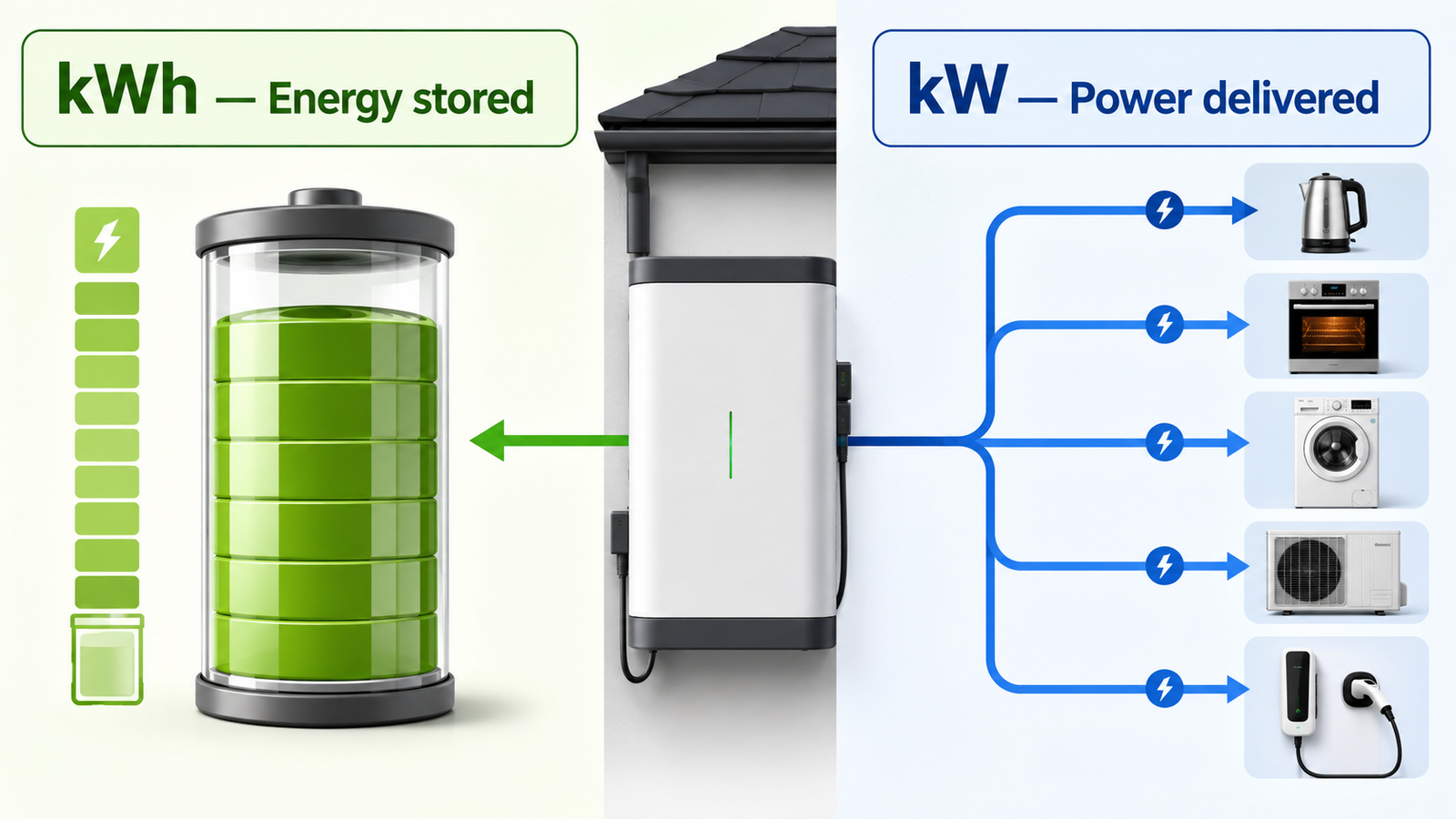
Battery specifications commonly use two units that are easy to confuse.
kWh — kilowatt-hours
This tells you how much energy the battery can store.
Think of it as the size of the tank.
kW — kilowatts
This tells you how much power the battery or inverter can deliver at a particular moment.
Think of it as how quickly electricity can leave the tank.
A battery could hold 10 kWh of energy but have an output of only a few kilowatts.
That means it might have enough stored energy to cover several hours of household consumption but still be unable to supply several high-demand appliances at the same time.
For example, ovens, kettles, electric showers, induction hobs, heat pumps and EV chargers can create substantial instantaneous demand.
So when comparing systems, ask two separate questions:
How much energy can it store?
and:
How much power can it deliver?
Looking only at battery capacity can result in the wrong system.
Nominal capacity and usable capacity
Another important specification is the difference between nominal and usable capacity.
Nominal capacity is the battery’s total theoretical energy capacity.
Usable capacity is the amount the system normally allows you to access.
Battery-management systems usually maintain a reserve instead of allowing the cells to be completely emptied during normal operation.
So two batteries both advertised as “10 kWh” may not necessarily provide exactly the same usable energy.
For homeowners, usable capacity is normally the more practical comparison figure.
What size battery should you consider?
A useful sizing process is:
1. Measure your consumption
Look at actual smart-meter or electricity-bill data.
2. Identify when you use electricity
A home using most of its electricity in the evening has a different storage opportunity from one with high daytime consumption.
3. Measure solar surplus
If you already have solar, determine how much generation is regularly exported during the day.
4. Decide what the battery is for
Your priorities might include:
- increasing solar self-consumption
- charging on cheap overnight electricity
- reducing peak-rate imports
- maintaining essential loads during outages
- preparing for an EV
- preparing for a heat pump
5. Consider future demand
Installing a battery that barely meets today’s needs may prove limiting if electricity use rises significantly later.
This is why a properly designed system should be based on a household energy profile rather than bedroom count alone.
How much does house battery storage cost in the UK?
Prices vary considerably.
As of August 2026, established UK consumer guidance places domestic battery systems across a broad range, from relatively small installations costing a few thousand pounds to larger systems approaching £10,000 or more.
A 5 kWh system has been estimated at roughly £4,600 in current consumer guidance, while a broader typical range of around £5,000 to £8,000 is also commonly used for complete domestic battery systems.
Those figures are useful for orientation, but they are not quotes.
Your actual installed price can depend on:
- battery capacity
- inverter size
- whether an inverter already exists
- AC- or DC-coupled design
- number of battery modules
- electrical-board upgrades
- cable routes
- battery location
- monitoring equipment
- backup-power hardware
- integration with existing solar
- manufacturer
- warranty
- labour complexity
A battery that appears cheap online may also exclude installation, inverter equipment, electrical work or backup components.
Compare complete installed systems rather than headline hardware prices.
What should a battery quote include?
Before comparing two prices, make sure they include the same things.
Ask for:
- battery model
- nominal capacity
- usable capacity
- inverter model
- continuous power output
- installation labour
- electrical alterations
- monitoring system
- DNO work where required
- backup hardware if required
- VAT treatment
- workmanship warranty
- battery warranty
A £5,000 quote and a £7,000 quote may represent very different systems.
Is home battery storage worth it?
Sometimes. Not always.
The answer depends mainly on how much expensive electricity the battery can replace over its life.
The basic economics can be thought of as:
value of electricity avoided
minus
cost of charging the battery
minus
energy losses
minus
any export income you give up
That value then needs to justify the installed cost.
A solar household
If solar electricity would otherwise be exported, storing it allows the home to use that energy later.
The saving is not necessarily equal to the full retail electricity price.
You should also consider the export payment you would have received.
For example, if using one stored kWh avoids buying expensive electricity later but you would otherwise have been paid for exporting that kWh, the real benefit is the difference between those two values, adjusted for battery losses.
A battery-only household
Here the calculation is different.
The battery purchases electricity from the grid during a cheap period and replaces electricity that would otherwise have been purchased during a more expensive period.
The wider the tariff spread, the greater the potential value.
But the battery still loses some energy while charging and discharging, so you cannot assume that every purchased kWh produces one usable kWh later.
Why simple payback claims can be misleading
Statements such as “a home battery pays for itself in five years” are usually too simplistic without knowing:
- purchase price
- tariff rates
- battery size
- daily utilisation
- solar generation
- export rate
- efficiency
- degradation
- household demand
The same battery could produce very different savings in two houses.
A realistic calculation should use actual household consumption and several plausible scenarios rather than one optimistic number.
Solar plus battery versus battery without solar
| Solar + battery | Battery without solar | |
|---|---|---|
| Main charging source | Surplus solar and possibly grid | Grid |
| Main purpose | Store solar for later use | Shift cheap grid electricity |
| Tariff importance | Useful | Often crucial |
| Solar export affected | Yes | No solar export |
| Works without sunshine | Can also grid-charge if configured | Yes |
| Backup automatically included | No | No |
Solar and storage are often discussed together, but neither is required for the other to exist.
The better arrangement depends on the property and tariff.
What is an AC-coupled battery?
An AC-coupled battery is commonly relevant when storage is being added to a home that already has solar panels.
It usually has its own inverter or conversion system and can operate alongside the existing solar installation.
This can make AC coupling convenient for retrofits.
A DC-coupled system generally integrates the solar panels and battery more directly on the DC side of the installation.
Neither design is automatically better.
The right choice depends on:
- existing solar equipment
- existing inverter
- efficiency
- retrofit complexity
- battery compatibility
- backup requirements
- installation cost
If a property already has solar, inverter compatibility should be checked before selecting a battery.
Will a home battery power the house during a blackout?
Do not assume it will.
A standard grid-connected battery system may shut down during a power cut for safety reasons.
Providing electricity when the grid is down normally requires a system specifically designed for backup operation.
You may see terms such as:
- EPS
- Emergency Power Supply
- backup output
- island mode
- essential loads
- whole-home backup
If backup matters, ask the installer exactly what is included.
Important questions include:
- Which circuits remain powered?
- Does backup start automatically?
- What is the maximum backup output?
- Can the battery run high-power appliances?
- Can solar recharge the battery during an outage?
- Is the entire house backed up or only selected circuits?
“Battery included” and “blackout backup included” are not the same thing.
How long does a home battery last?
A rough expectation for domestic batteries is around 10 to 12 years, although actual service life varies.
Battery cells gradually lose some capacity as they age.
The rate of degradation can depend on:
- battery chemistry
- temperature
- charging behaviour
- discharge depth
- number of cycles
- power levels
- system management
This makes the warranty particularly important.
What to look for in a battery warranty
Do not judge a warranty only by the number of years printed on the brochure.
Check:
- warranty length
- maximum cycle count
- energy-throughput limit
- minimum guaranteed capacity
- exclusions
- required operating conditions
- labour coverage
- replacement terms
A ten-year warranty with restrictive throughput conditions can be less valuable than it initially appears.
Also check whether warranty support comes from the installer, distributor or manufacturer.
How efficient is battery storage?
A battery cannot return every unit of electricity that goes into it.
Energy is lost through:
- charging
- conversion
- storage
- inverter operation
- discharge
This is normally described using efficiency or round-trip efficiency.
The practical result is straightforward:
If you put 10 kWh into a battery, you should expect to get less than 10 kWh back for household use.
That matters when calculating savings.
Suppose cheap electricity costs significantly less than peak electricity. Some of that price advantage will be consumed by battery losses.
The tariff spread needs to be worthwhile after those losses are considered.
Where can a home battery be installed?
Possible locations can include:
- garages
- utility spaces
- suitable external walls
- dedicated equipment areas
But there is no single correct location for every battery.
The installer needs to consider:
- manufacturer instructions
- temperature limits
- ventilation
- fire safety
- escape routes
- physical damage risk
- weather exposure
- cable length
- electrical access
- maintenance access
A battery should not simply be placed wherever there happens to be free space.
Home battery safety in the UK
Domestic batteries store a large amount of energy, so safe design and installation matter.
Battery fire risk cannot be described as zero, but properly designed and professionally installed domestic systems are expected to incorporate multiple layers of protection.
Current UK installation practice includes standards covering electrical design, battery siting and fire safety.
Two names homeowners may encounter are:
PAS 63100:2024
This addresses fire-safety requirements for domestic battery energy storage installations.
MCS MIS 3012
This relates to the design, supply and installation of domestic electrical energy-storage systems.
Homeowners do not need to become experts in those documents, but installers should understand the requirements that apply to a proposed system.
For a major electrical installation, professional assessment is much safer than attempting a DIY battery installation.
Do you need DNO approval?
Battery installations may need involvement from the local Distribution Network Operator, or DNO.
The DNO is responsible for the electricity network serving your property.
The connection process depends on system design, inverter capacity and whether the installation can export electricity.
Some installations can follow simplified processes, while others require approval before connection.
Ask the installer:
- Does my system require DNO approval?
- Is notification enough?
- Will you handle the application?
- Is export limiting required?
- Could network restrictions affect inverter size?
These questions should be answered before installation, not discovered afterwards.
Home batteries and solar export payments
If a home has solar panels, storing electricity changes how much power is exported.
Instead of exporting surplus generation immediately, the battery may capture some of it for later household use.
Once the battery is full, additional solar electricity may still be exported.
Whether exported electricity qualifies for a particular Smart Export Guarantee tariff depends on the generation, metering and supplier arrangement.
Do not assume every unit discharged from a battery earns an export payment.
For most homeowners, the useful comparison is:
Is this unit of electricity more valuable if I export it now or store it and avoid buying electricity later?
The answer can change with tariff rates.
Time-of-use tariffs can change the economics
A battery becomes more financially interesting when electricity prices vary substantially throughout the day.
A smart tariff may offer:
- cheap overnight charging
- expensive peak-period electricity
- separate export payments
That creates opportunities for load shifting.
But tariff rates can change.
A battery should not be purchased solely because one attractive tariff exists today unless the economics still make reasonable sense under less favourable assumptions.
A more robust assessment could test:
- current tariff
- smaller peak/off-peak difference
- lower export rate
- reduced battery utilisation
If the investment only works under the most optimistic scenario, that is useful information before buying.
VAT on home battery storage
Tax treatment is unusually important for installations taking place in 2026.
As of 30 August 2026, qualifying electrical storage battery installations can receive 0% VAT under the UK’s energy-saving materials rules.
The current zero rate is scheduled to run until 31 March 2027.
From 1 April 2027, qualifying installations are scheduled to move to the reduced 5% VAT rate.
The relief can apply to installed battery systems that:
- store grid electricity
- are added to renewable generation
- store a combination of renewable and mains electricity
There is an important distinction between an installed system and simply buying equipment.
Buying a battery as a standalone retail product does not automatically make the purchase zero-rated. The VAT treatment depends on the qualifying supply and installation arrangement.
Because this rule is time-sensitive, homeowners arranging work around March or April 2027 should check the current HMRC position before signing a contract.
Are home battery grants available?
Support varies by scheme, region and household circumstances.
The government’s Warm Homes programme includes battery storage within parts of its wider home-energy strategy, including support intended for some lower-income households and financing initiatives for technologies such as solar and batteries.
However, that does not mean every homeowner can currently claim a national battery grant or immediately obtain a government-backed zero-interest battery loan.
As of August 2026, parts of the new finance programme were still progressing through lender and product development.
Treat any statement such as “free home batteries for everyone” with caution.
Before relying on support, check:
- whether the scheme is currently open
- postcode restrictions
- income requirements
- property requirements
- eligible technologies
- approved installers
- application deadlines
Do not agree to an installation based only on a salesperson’s promise that a grant will definitely cover the cost.
What to ask before buying house battery storage
A good battery proposal should make the system understandable.
Before accepting a quote, ask for these details:
- What is the battery’s usable capacity?
- What is its continuous power output?
- What is the maximum charging rate?
- What is the maximum discharge rate?
- What efficiency figure applies to the complete system?
- Why has this battery size been recommended?
- What consumption data was used?
- Will it work with my existing solar inverter?
- Can additional battery modules be added later?
- Does it provide blackout backup?
- Which circuits are backed up?
- What is the backup power limit?
- Where will the battery be installed?
- How does the location meet current safety requirements?
- Who handles the DNO process?
- Can the system charge automatically during cheap tariff periods?
- What happens if the manufacturer’s internet service is unavailable?
- What does the battery warranty actually guarantee?
- What workmanship warranty is included?
- What is the total installed price?
The best proposal should also show estimated savings using your household’s actual electricity profile.
Common mistakes when choosing a home battery
Buying based on bedroom count
A four-bedroom house does not automatically consume more electricity than a three-bedroom house.
Measure actual usage.
Choosing the largest battery possible
Bigger is not always better.
Unused capacity costs money without necessarily producing more savings.
Looking only at kWh
Power output in kW can be equally important.
Ignoring usable capacity
The advertised capacity may not all be available for daily use.
Assuming solar is required
Grid-charged battery storage is a legitimate alternative.
Assuming backup is standard
It often is not.
Ignoring export payments
Stored solar electricity may have had an alternative value if exported.
Trusting one payback number
Battery economics vary too much for a generic number to be reliable.
Frequently asked questions
What is the best battery size for a typical UK house?
There is no single best size. Around 10 kWh is often discussed for domestic installations, but actual requirements should be based on electricity consumption, timing of use, solar generation, tariff and future demand.
Can a home battery charge from the grid?
Yes. It can charge from mains electricity, which makes battery-only systems possible without solar panels.
Is a 5 kWh battery enough for a house?
It can be enough for some households and too small for others. Compare its usable capacity with the amount of electricity you actually want to shift between charging and discharge periods.
Can a 10 kWh battery run a whole house?
It may contain enough energy to cover a significant period of consumption, but capacity alone is not enough. The inverter’s maximum power output determines how many high-demand appliances can be supplied simultaneously.
Can I add another battery later?
Many modular systems allow expansion, but compatibility varies. If you expect electricity demand to rise, check expansion rules before buying the original system.
Does home battery storage work in winter?
Yes, but a solar-connected battery may have less surplus solar available to charge it during darker months. Grid charging can still be used where the system and tariff support it.
Does a battery reduce electricity bills?
It can. The size of the saving depends on how much electricity is shifted, charging cost, solar export value, efficiency, tariff and household behaviour.
Does a battery automatically protect against power cuts?
No. Backup requires the appropriate battery, inverter, switching and electrical configuration.
Conclusion
House battery storage is most useful when it solves a clearly defined energy problem.
For one homeowner, that may mean storing midday solar power for the evening. For another, it may mean charging cheaply overnight. A third may care most about backup during outages.
Those goals can require different battery capacities, inverters and system designs.
Before choosing a battery, understand your own electricity use, decide what the system needs to accomplish and compare proposals using usable capacity, power output, tariff assumptions, warranty terms and complete installed cost. A battery chosen around real household data is far more likely to deliver useful value than one chosen simply because its headline capacity looks impressive.

1 Comment
Pingback: Battery Storage Calculator UK: Size, Savings & Payback (2026)